This Is No Longer a Technology Debate
For years, businesses compared payment systems based on:
Speed
Cost
That comparison is now outdated.
The real comparison today is:
Exposure vs Control
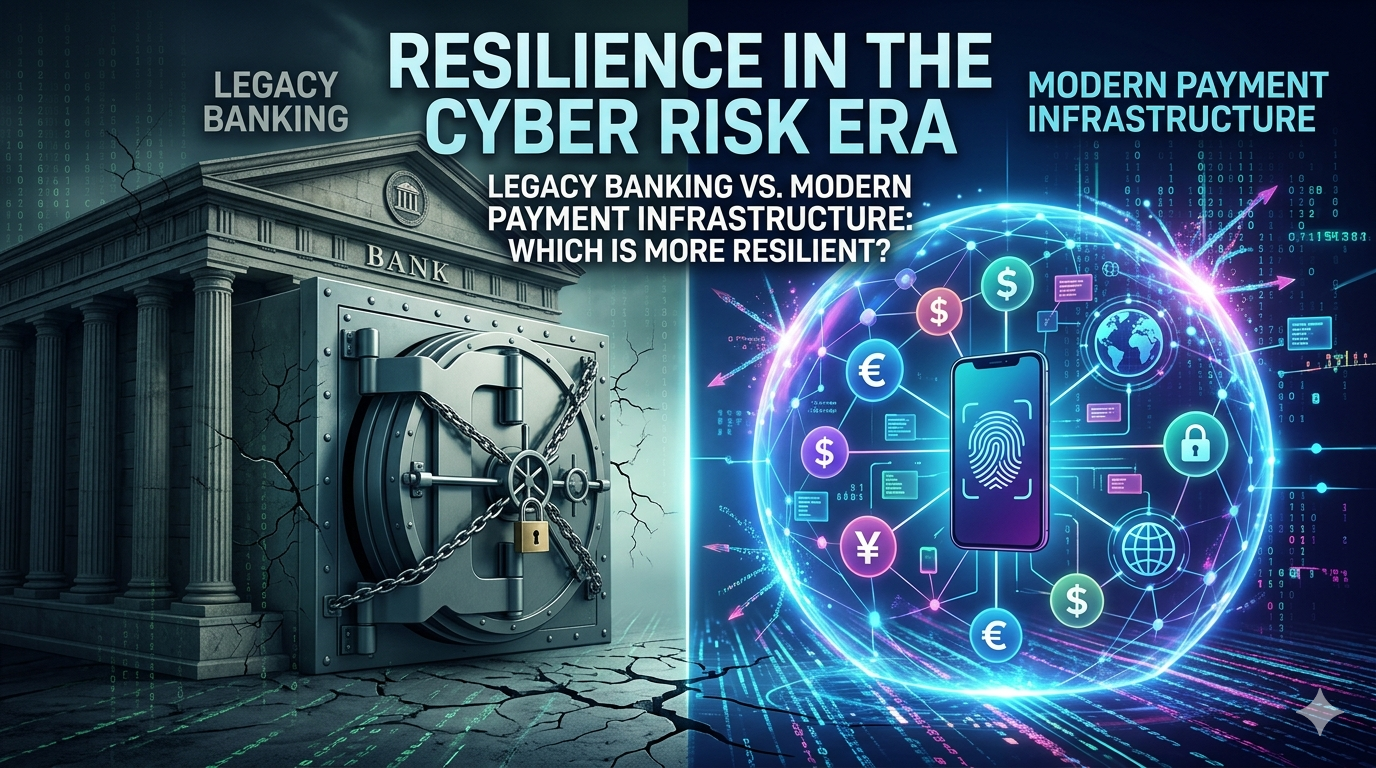
Two Systems — Two Risk Profiles
Legacy Banking Systems
Multi-layered
SWIFT-dependent
Interconnected globally
Modern Digital Payment Ecosystems
Streamlined
Controlled
Reduced dependency
These are not just different systems
They represent different risk architectures
The Problem with Legacy Banking in Today’s Environment
Structural Reality
Legacy systems depend on:
Multiple banks
Multiple networks
Multiple validation layers
This creates:
Complexity
Delays
Exposure
Now Add AI-Driven Cyber Risk
AI systems can:
Identify system weaknesses
Exploit interconnected infrastructure
Accelerate attack patterns
Result:
Complex systems become vulnerable systems
The Critical Weakness: Dependency Chains
Each payment depends on:
External institutions
External systems
External timing
Businesses do not control these variables
This Is Where Modern Systems Win
Modern Digital Payment Ecosystems:
Reduce intermediaries
Simplify flow
Increase control
Key Differentiator:
They operate independently of traditional SWIFT banking rails
Why This Matters in a Cyber Risk Environment
Legacy Systems:
Broad exposure surface
Multiple entry points
Distributed responsibility
Modern Systems:
Narrower exposure surface
Controlled execution
Centralized clarity
This is not incremental improvement
This is structural risk reduction
The Role of Proprietary Digital Payment Tokens
Instead of relying on:
Multi-currency conversions
Bank-controlled liquidity
These systems use:
A dedicated digital value layer
Impact:
Predictable transactions
Reduced friction
Simplified execution
This Is a Risk Loss Mitigation Solution
Let’s be direct.
Legacy Banking:
Exposure increases with complexity
Modern Ecosystem:
Exposure decreases with simplification
This is a designed risk mitigation model
Why This Matters for Africa & Latin America
Businesses in these regions already face:
Currency volatility
Banking limitations
External dependency
Adding system-level risk increases vulnerability significantly
A controlled ecosystem reduces this risk.
Decision Framework for Businesses
Ask:
How many systems does my payment rely on?
Where do I lose control?
What happens if one layer fails?
If answers are unclear — risk is high
Strategic Conclusion
This is not about replacing banks.
This is about reducing reliance on vulnerable systems
And introducing:
A controlled, resilient payment layer
Final Thought
In today’s environment:
Efficiency is important
But resilience is critical
Businesses that reduce exposure will outperform those that don’t.