Not a Trend — A Structural Shift
Across Africa, something more fundamental than a fintech trend is unfolding. Businesses are rethinking how money should move — not just faster, but smarter.
For years, cross-border payments have depended on layered banking systems. That model is now being challenged by a different approach:
👉 Blockchain-based business payments
This isn’t about speculation or hype.
It’s about solving real problems for companies moving $50,000 to $10,000,000+ across borders.
Why Africa Is Ripe for Payment Innovation
Africa’s payment challenges are not accidental — they are structural.
Fragmented Systems
Each country operates independently:
Different currencies
Different banking rules
Different infrastructure
👉 This makes cross-border transactions complex by default.
Limited Correspondent Banking
Many African banks rely on external correspondent networks to process international payments.
👉 This introduces:
Additional costs
Extra delays
Reduced control
Currency Instability
Local currencies can fluctuate rapidly, making international transactions unpredictable.
High Cost Environment
Businesses routinely lose:
5%–10% in transaction costs
Additional value in FX spreads
👉 For high-value transactions, this is a major financial drain.
What Is Blockchain in Business Payments (Without the Jargon)
Let’s simplify this.
Blockchain is essentially a shared digital ledger that allows transactions to be:
Verified
Recorded
Completed
👉 Without relying on multiple intermediaries.
What This Means for Businesses
Instead of:
Bank → Intermediary → Intermediary → Recipient
You get:
👉 Direct, verifiable transfer
How Blockchain Changes the Payment Flow
Traditional Flow
Payment initiated
Routed through multiple banks
Delayed processing
Final settlement
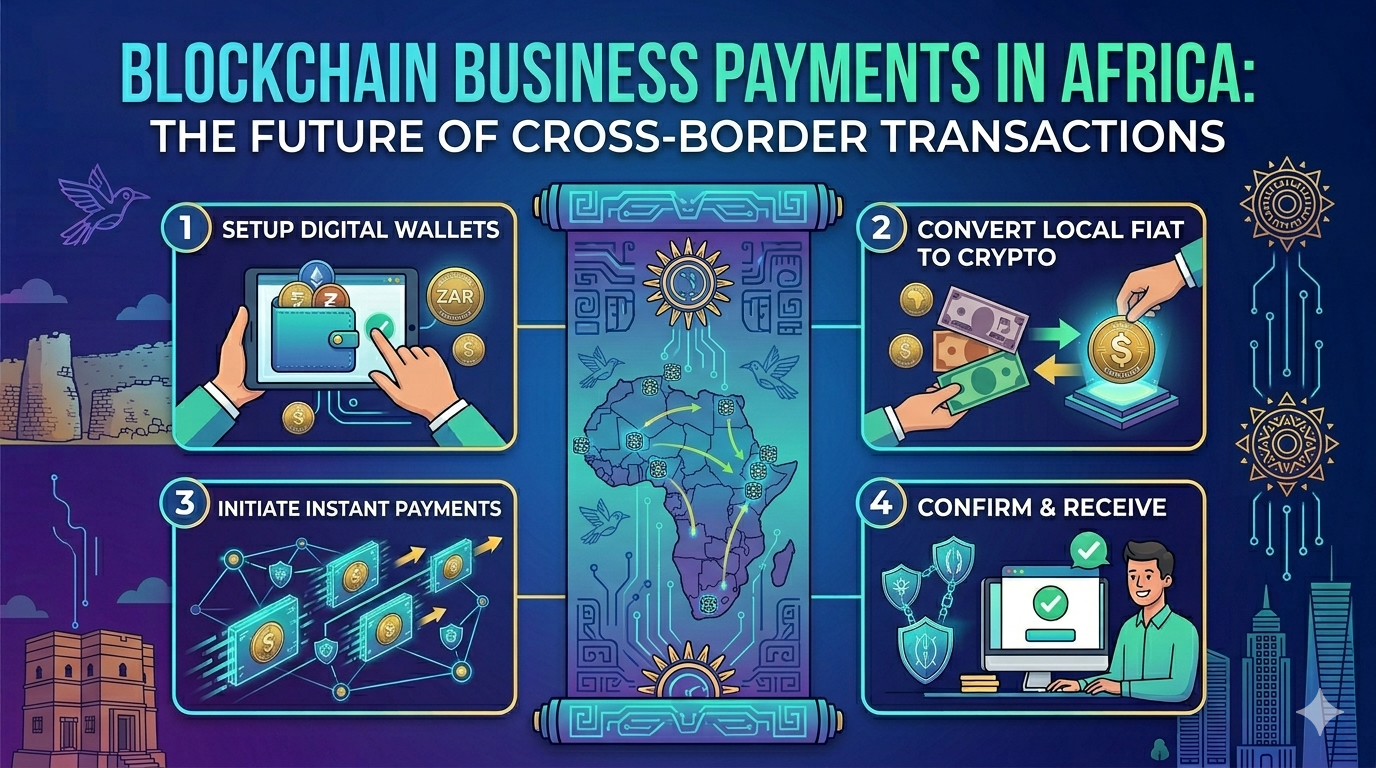
Blockchain-Based Flow
Payment initiated
Verified digitally
Transferred directly
Settled quickly
👉 Fewer steps = fewer costs + faster outcomes
Why Businesses in Africa Are Adopting Blockchain Payments
1. Speed That Matches Business Needs
Traditional systems take days.
Blockchain-based systems can complete transactions much faster.
👉 This aligns payments with real business timelines.
2. Cost Efficiency at Scale
Removing intermediaries reduces:
Transaction fees
Processing costs
👉 Especially important for large payments.
3. Predictable Value
Using stable digital assets allows businesses to avoid:
Currency fluctuations
Unexpected losses
4. Transparency and Control
Every transaction is recorded and trackable.
👉 Businesses gain visibility they never had before.
5. Accessibility Across Markets
Blockchain systems are not limited by:
Banking availability
Geographic restrictions
👉 This opens access to global markets.
Real Business Scenarios in Africa
Scenario 1: Export Company in Nigeria
A company exporting goods needs to receive payments from Europe.
Traditional system:
Delays
FX uncertainty
High fees
Blockchain-based system:
Faster settlement
Stable value
Lower cost
Scenario 2: Supplier Payments in Kenya
A business pays international suppliers regularly.
Challenge:
Delayed payments affect relationships
Solution:
Faster, more reliable payments improve trust
Scenario 3: Enterprise Operations in South Africa
A multinational company moves funds across regions.
Challenge:
Complex multi-bank processes
Solution:
Simplified payment execution
The Role of Stable Digital Assets
Blockchain payments often use USD-linked digital assets.
Why This Matters
Stable value (1:1 with USD)
No FX volatility
Easier international transactions
👉 This combines the speed of blockchain with the stability of USD.
Strategic Impact on African Businesses
Stronger Cash Flow
Faster payments improve liquidity.
Better Supplier Relationships
Timely payments build trust.
Lower Operational Costs
Reduced fees increase margins.
Faster Market Expansion
Businesses can operate across borders more efficiently.
What Businesses Should Evaluate
Before adopting new systems, companies should assess:
Payment volumes
Transaction frequency
Cost structure
Operational needs
👉 The goal is to improve efficiency, not just adopt new technology.
Challenges to Consider
Regulatory Landscape
Different countries have different rules.
👉 Compliance is key.
Internal Adoption
Teams may need to adapt to new workflows.
Integration
Systems must align with existing operations.
👉 These challenges are manageable with the right setup.
The Bigger Picture: Africa Leading Innovation
Africa is not waiting for legacy systems to improve.
Instead, businesses are:
Skipping outdated infrastructure
Adopting modern systems directly
Building more efficient financial operations
👉 This is a leap forward, not a gradual shift.
The Future of Cross-Border Payments in Africa
The direction is clear.
Businesses are moving toward:
Faster systems
Lower-cost models
More transparent processes
Blockchain-based payments will play a major role in this transformation.
Conclusion
Blockchain business payments in Africa are solving real problems:
High costs
Slow transactions
Lack of transparency
For businesses handling high-value transactions, this approach offers:
Efficiency
Reliability
Scalability
Final Perspective
If your business operates across borders in Africa…
👉 The real opportunity is not just adopting new technology
👉 It’s building a smarter way to move money
Frequently Asked Questions
What are blockchain business payments?
They are transactions processed using blockchain technology instead of traditional banking systems.
Why are businesses in Africa adopting blockchain payments?
To reduce costs, improve speed, and overcome banking limitations.
Are blockchain payments suitable for large transactions?
Yes, they are effective for high-value business payments.
How do blockchain payments reduce costs?
By eliminating intermediaries and reducing processing overhead.
Are these payments secure?
Yes, when implemented using reliable and compliant systems.