A Simple Invoice… That Turns Into a Complex Problem
It starts with something simple.
A business issues an invoice.
A supplier in Nigeria sends an invoice to a buyer in Europe
A service provider in Mexico bills a client in the US
A logistics company in Brazil charges an international partner
Everything looks straightforward - until the payment begins.
What should be a simple transaction becomes:
Delayed
Reduced in value
Difficult to track
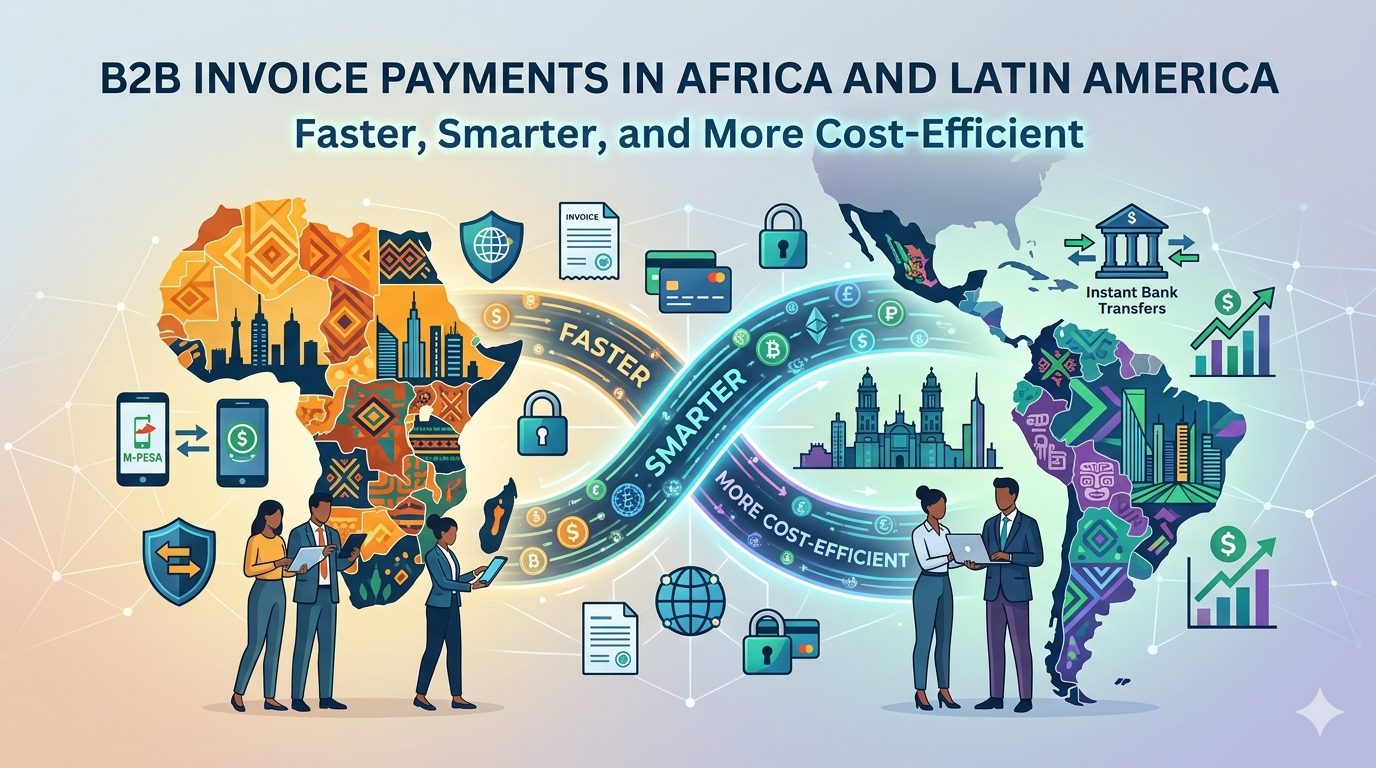
For businesses dealing with B2B invoice payments in Africa and Latin America, this is not an occasional issue - it’s a recurring operational challenge.
Why Invoice Payments Are Critical to Business Health
Invoice payments directly impact:
Cash Flow
Delayed payments = delayed operations
Profit Margins
Fees and FX losses reduce revenue
Business Relationships
Late payments affect trust
Growth Potential
Inefficient systems slow expansion
👉 In short, invoice payments are not just financial — they are strategic.
The Hidden Complexity Behind Invoice Payments
Most businesses assume invoice payments are simple.
They’re not.
Step-by-Step Reality
Invoice is issued
Payment is initiated
Routed through multiple banks
Converted across currencies
Final amount received
👉 At each step:
Time is lost
Value is reduced
Complexity increases
The True Cost of Invoice Payments
Example: $250,000 Invoice
Traditional Payment Breakdown:
Bank fees: $5,000–$10,000
FX losses: $3,000–$7,000
Delay: 3–5 days
👉 Total impact:
Reduced revenue
Slower operations
Now multiply this across multiple invoices.
👉 The cost becomes massive.
Why Africa & LATAM Face Bigger Challenges
Africa
Limited banking infrastructure
Currency instability
Heavy reliance on correspondent banks
Latin America
FX volatility
Complex regulations
Fragmented financial systems
👉 These factors make invoice payments even harder.
What Businesses Are Realizing
Businesses are starting to ask:
👉 “Why are we losing money just to receive payments?”
Instead of optimizing the old system, they are shifting to:
👉 Modern payment infrastructure
The New Model: Stablecoin Invoice Payments
What Changes?
Traditional:
Invoice → Bank → Intermediaries → Payment
Modern:
👉 Invoice → Direct digital settlement
👉 Fewer steps = better efficiency
How Stablecoin Invoice Payments Work
Step 1: Invoice Issued
Same as traditional process.
Step 2: Payment Method Defined
Instead of bank transfer, payment uses stable digital assets.
Step 3: Payment Execution
Funds are transferred directly.
Step 4: Settlement
Payment is completed quickly with full value.
👉 The process is simplified without changing business workflows.
Why This Model Works Better
Stable Value
No currency fluctuations.
Faster Settlement
Payments are completed quickly.
Lower Costs
Reduced intermediaries.
Transparency
Better tracking and visibility.
Real Business Impact
Improved Cash Flow
Faster payments mean better liquidity.
Reduced Revenue Loss
No hidden deductions.
Better Vendor & Client Relationships
Reliable payments build trust.
Operational Efficiency
Less manual work for finance teams.
Use Cases Across Industries
Export Businesses
Receive payments faster.
SaaS Companies
Improve subscription billing globally.
Logistics Companies
Simplify cross-border transactions.
Consulting & Services
Get paid reliably across regions.
Decision Framework for Businesses
Ask yourself:
1. How much do we lose per invoice?
2. How long do payments take?
3. How much manual work is involved?
4. Can this be improved?
👉 If the answer is yes — change is needed.
Common Concerns (And Reality)
“This sounds complex”
👉 Reality: Systems are becoming simple and user-friendly
“Is it safe?”
👉 Yes — depends on infrastructure
“Will clients accept it?”
👉 Increasingly, yes
The Bigger Shift
Invoice payments are evolving from:
👉 Manual + bank-dependent
to
👉 Automated + digital
👉 This is a structural change, not a temporary trend.
The Future of Invoice Payments
Businesses are moving toward:
Faster systems
Lower-cost infrastructure
Simplified workflows
👉 Invoice payments will become:
Instant
Transparent
Predictable
Conclusion
B2B invoice payments in Africa and Latin America are undergoing a major transformation.
Businesses that adopt modern payment systems gain:
Faster payments
Lower costs
Better efficiency
Stronger relationships
Final Insight
If your business depends on invoices…
👉 Then your payment system defines your financial performance
Frequently Asked Questions
What are B2B invoice payments?
They are payments made between businesses for goods or services.
Why are invoice payments slow in Africa and LATAM?
Due to banking inefficiencies, intermediaries, and FX processes.
How can businesses improve invoice payments?
By using modern payment systems that reduce delays and costs.
Are stablecoin invoice payments reliable?
Yes, when implemented correctly.
Can large invoices be processed efficiently?
Yes, modern systems support high-value transactions.