Introduction: The Hidden Cost Problem in Global Payments
For businesses operating internationally, sending money across borders is not just a routine process — it’s a major cost center.
While most companies focus on visible fees, the real cost of high-value international payments goes far beyond transaction charges. Hidden expenses like foreign exchange losses, intermediary banking fees, and settlement delays quietly eat into profits.
For transactions ranging from $50,000 to $10,000,000, even a small percentage loss can translate into tens or hundreds of thousands of dollars.
This is where stablecoin-based payment infrastructure is changing the game.
Why High-Value International Payments Are So Expensive
Before understanding how to reduce costs, it’s important to identify where the money is actually going.
1. Intermediary Banking Fees
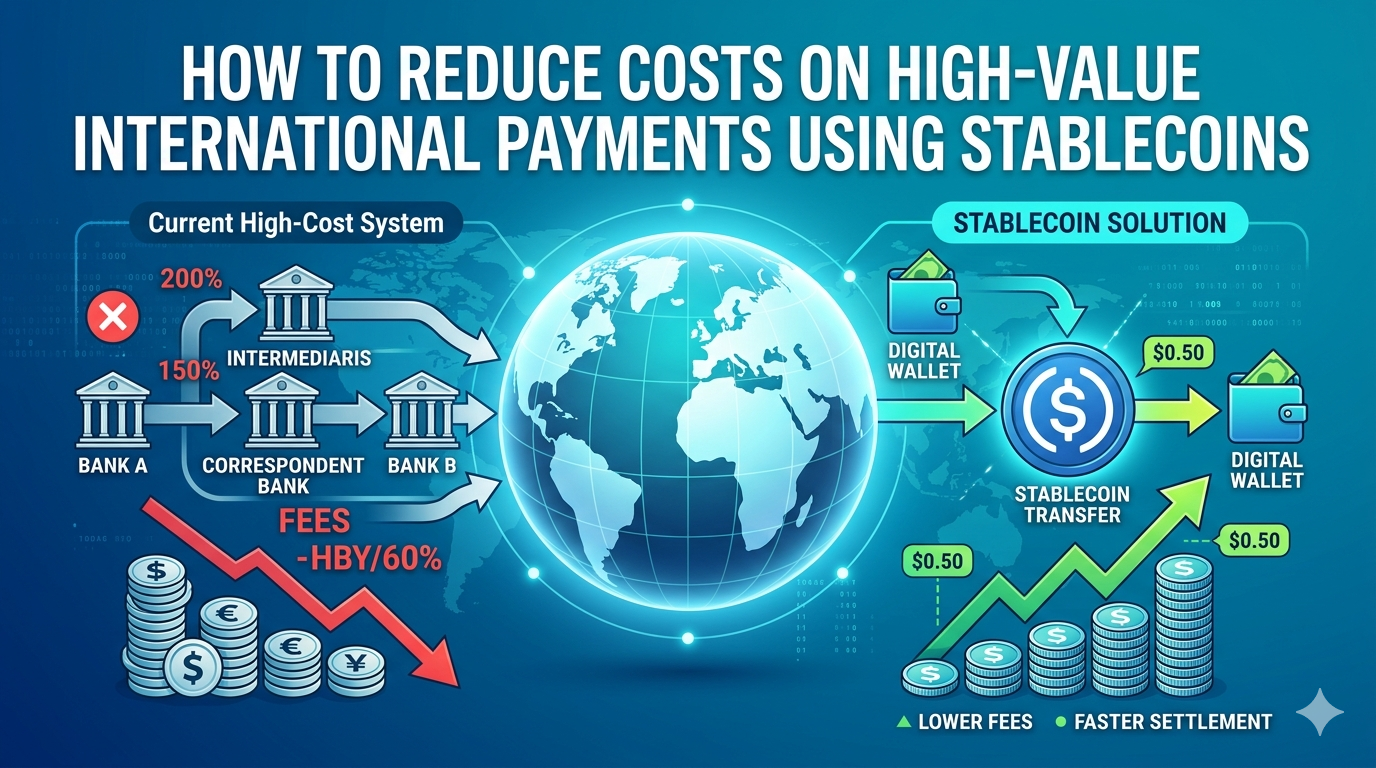
Traditional cross-border payments often involve multiple banks. Each intermediary takes a fee, increasing the total cost of the transaction.
👉 For large payments, this can add up significantly.
2. Foreign Exchange (FX) Losses
Currency conversion is one of the biggest hidden costs.
Exchange rate margins
Currency fluctuations
Timing differences
👉 Businesses often lose 2%–5% purely due to FX.
3. Processing Delays
Time is money — especially in business.
Delays of 2–5 days can:
Disrupt cash flow
Delay operations
Impact supplier relationships
4. Lack of Transparency
Many businesses don’t know:
Exact fees charged
Where the money is held
When it will arrive
👉 This lack of visibility creates inefficiency.
The Real Cost Breakdown (Example)
Let’s consider a $500,000 international payment:
Bank fees: $10,000–$20,000
FX losses: $10,000–$15,000
Total cost: $20,000–$35,000
👉 This is a massive cost for a single transaction.
What Are Stablecoins and Why They Matter
Stablecoins are digital currencies pegged to stable assets like the US Dollar.
Examples include:
USDT
USDC
Key Characteristics:
Stable value (1:1 with USD)
Fast global transfers
Blockchain-based infrastructure
👉 They eliminate many of the inefficiencies found in traditional systems.
How Stablecoins Reduce Payment Costs
Now let’s look at how stablecoins directly reduce costs.
1. Eliminating Intermediaries
Stablecoin payments operate on decentralized infrastructure.
👉 No multiple banks
👉 No layered fees
Result: Lower transaction costs
2. Removing FX Losses
Since stablecoins are USD-backed:
👉 No currency conversion required
👉 No FX volatility
Result: Predictable payment value
3. Faster Settlement
Transactions can be completed within minutes.
Result:
Better cash flow
Faster business operations
Reduced opportunity cost
4. Transparent Transactions
Blockchain provides full visibility:
Transaction tracking
Real-time confirmation
Result: Improved efficiency and trust
Real-World Impact on Businesses
Businesses adopting modern payment systems experience:
Improved Profit Margins
Reducing transaction costs directly increases profitability.
Faster Operations
Payments are no longer a bottleneck.
Better Vendor Relationships
Faster payments build trust and reliability.
Global Scalability
Businesses can operate across multiple markets without friction.
Use Cases Where Cost Reduction Matters Most
1. Large Invoice Payments
High-value invoices amplify cost inefficiencies.
2. Supplier Payments
Frequent payments increase cumulative costs.
3. Cross-Border Trade
Import/export businesses benefit significantly.
4. Enterprise Transactions
Large-scale payments require efficiency and reliability.
Strategic Advantage: Beyond Cost Savings
Reducing costs is just one part of the equation.
Businesses also gain:
Competitive advantage
Faster decision-making
Improved financial control
👉 Payment efficiency becomes a strategic asset.
Key Considerations Before Switching
Businesses should evaluate:
Transaction volume
Payment frequency
Current cost structure
Operational requirements
👉 This helps determine potential savings.
The Future of Cost-Efficient Global Payments
Global payment systems are evolving.
Businesses are moving toward:
Digital infrastructure
Faster settlement systems
Lower-cost models
Stablecoin-based payments are at the center of this shift.
Conclusion
High-value international payments don’t have to be expensive.
By understanding the true cost structure and adopting more efficient systems, businesses can:
Reduce costs significantly
Improve operational efficiency
Scale globally with confidence
Final Thought
If your business is sending large international payments…
👉 The real question is not whether you can reduce costs
👉 It’s how much you are currently losing without realizing it
Frequently Asked Questions
How can businesses reduce international payment costs?
By using modern payment systems that eliminate intermediaries and reduce FX losses.
What are stablecoins used for in business payments?
They are used to send fast, stable, and cost-efficient cross-border payments.
Are stablecoin payments cheaper than banks?
Yes, they significantly reduce transaction and FX-related costs.
Can stablecoins handle large payments?
Yes, they are suitable for high-value transactions.