A Quiet Shift in Global Payments
Something interesting is happening in global finance.
While headlines focus on fintech innovation in developed markets, a more practical transformation is unfolding behind the scenes — businesses are quietly changing how they move money across emerging markets.
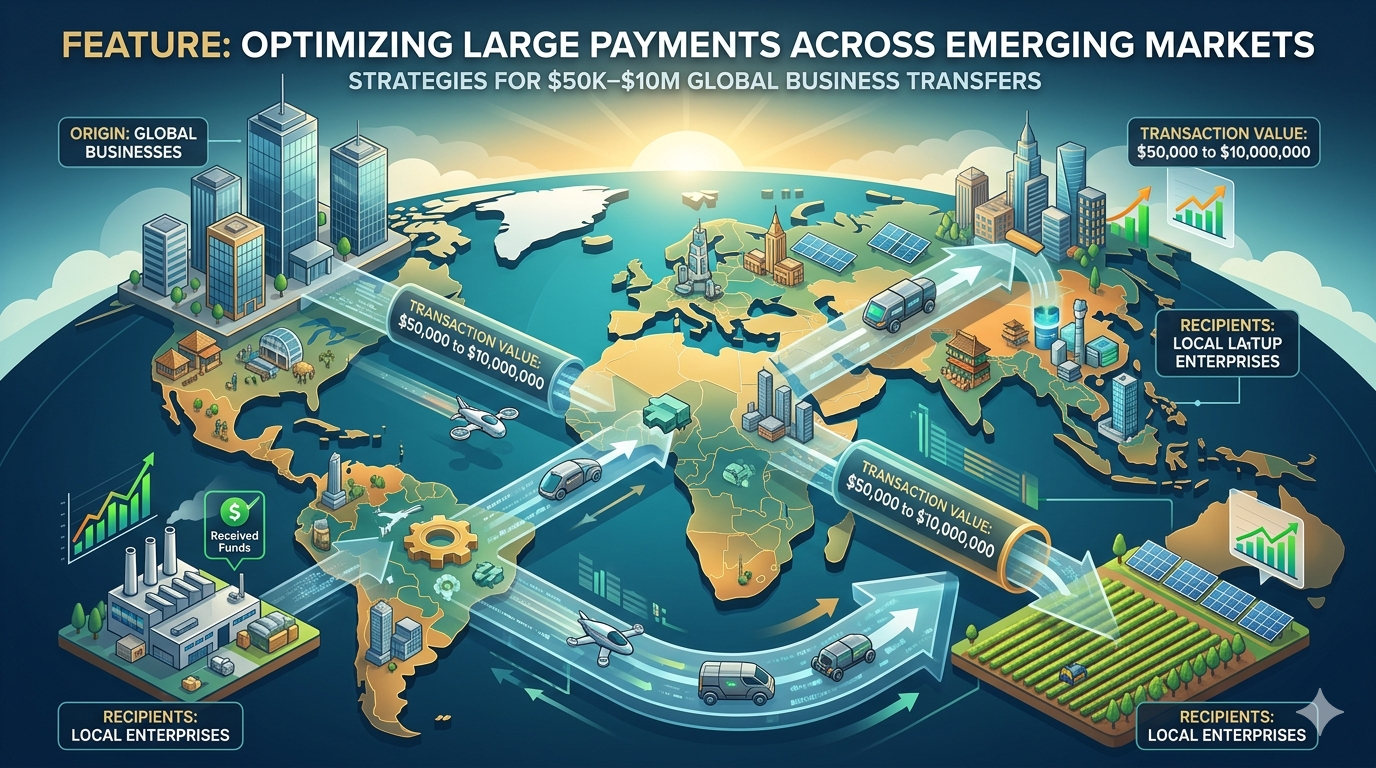
From Africa to Latin America, companies are no longer relying entirely on traditional banking systems to send high-value payments. Instead, they are adopting faster, more efficient infrastructure to move transactions ranging from $50,000 to $10,000,000.
This shift isn’t driven by hype.
It’s driven by necessity.
Why Emerging Markets Are Different
Emerging markets operate under a very different financial reality compared to developed economies.
Businesses in regions like:
Nigeria
Kenya
Brazil
Mexico
Guyana
face unique challenges when dealing with international payments.
1. Infrastructure Gaps
Traditional banking systems are often:
Fragmented
Slow
Inconsistent across regions
2. Currency Volatility
Local currencies can fluctuate significantly, making it difficult to predict the final value of a payment.
3. High Transaction Costs
Businesses frequently lose money due to:
FX conversion margins
Intermediary banking fees
4. Delayed Settlements
Payments can take several days — sometimes longer — to complete.
👉 For high-value transactions, these challenges become critical.
The $50K–$10M Problem
Small payments can tolerate inefficiencies.
Large payments cannot.
When businesses send:
$50,000
$500,000
$5,000,000
even a small percentage loss results in significant financial impact.
Example:
A $1,000,000 transaction with a 5% cost = $50,000 lost
👉 This is why businesses handling large payments are actively looking for better solutions.
What Global Businesses Are Doing Differently
Instead of trying to optimize traditional systems, companies are changing the infrastructure itself.
They are adopting:
👉 Modern digital payment systems designed for cross-border efficiency
The Rise of Stable, Digital Payment Infrastructure
One of the most effective approaches is using stable, USD-linked digital assets for cross-border transactions.
This approach changes how payments work at a fundamental level.
Key Differences:
Traditional system:
Bank → intermediary → intermediary → recipient
Modern system:
Direct transfer using digital infrastructure
👉 Fewer steps = lower cost + faster execution
How Businesses Are Sending Large Payments Today
Let’s break down how companies are actually executing high-value transactions.
Step 1: Payment Initiation
Businesses initiate payments through digital platforms rather than traditional banks.
Step 2: Stable Value Transfer
Instead of converting currencies multiple times, payments are sent using assets that maintain a consistent value.
Step 3: Direct Settlement
Funds are transferred directly to the recipient without multiple intermediaries.
Step 4: Instant Confirmation
Transactions are confirmed quickly, improving visibility and control.
Why This Approach Works in Emerging Markets
This model solves the exact problems businesses face.
Faster Payments
Transactions are completed in minutes instead of days.
Lower Costs
Reduced reliance on intermediaries lowers fees significantly.
No FX Uncertainty
Using stable value eliminates currency fluctuations.
Greater Accessibility
Businesses can operate globally without depending on complex banking systems.
Real-World Scenarios
Scenario 1: Supplier Payment in Africa
A company in Europe pays a supplier in Nigeria:
Traditional system: multiple delays + high fees
Modern system: faster settlement + predictable value
Scenario 2: Trade Payment in Latin America
A business in Brazil sends payment to an international vendor:
Traditional system: FX loss + delays
Modern system: faster, cost-efficient
Scenario 3: Enterprise-Level Transactions
A global company moves millions across regions:
Traditional system: operational complexity
Modern system: simplified execution
What This Means for Global Businesses
Businesses are no longer treating payments as a back-office function.
They are recognizing that:
👉 Payment efficiency directly impacts:
Profit margins
Operational speed
Global scalability
The Competitive Advantage
Companies that adopt efficient payment systems gain:
Cost Advantage
Lower transaction costs improve profitability.
Speed Advantage
Faster payments accelerate business cycles.
Operational Advantage
Simplified processes reduce complexity.
Market Advantage
Ability to operate efficiently in emerging markets.
What to Consider Before Adopting a New Payment System
Businesses should evaluate:
Transaction size and frequency
Cost structure
Regional requirements
Operational impact
👉 The goal is not just faster payments, but smarter financial operations.
The Future of Payments in Emerging Markets
Emerging markets are not waiting for traditional systems to evolve.
They are leapfrogging directly to:
Faster infrastructure
Digital payment systems
More efficient models
👉 This trend will continue to accelerate.
Conclusion
Global businesses are redefining how money moves across borders.
For high-value transactions between $50K and $10M, traditional systems are no longer sufficient.
By adopting modern payment infrastructure, businesses can:
Reduce costs
Improve speed
Expand globally with confidence
Final Thought
If your business operates across emerging markets…
👉 The question is not how to send payments
👉 It’s whether your current system is costing you more than you realize
Frequently Asked Questions
How are businesses sending large cross-border payments today?
Many businesses are adopting modern digital payment systems that enable faster and more efficient transactions.
Why are emerging markets challenging for payments?
Due to infrastructure gaps, currency volatility, and high transaction costs.
Can large payments be sent efficiently across borders?
Yes, modern payment systems are designed to handle high-value transactions efficiently.
What is the biggest cost in international payments?
Foreign exchange losses and intermediary fees are major contributors.