Introduction: When Payments Become a Strategic Bottleneck
For enterprise organizations, cross-border payments are not just operational tasks — they are critical components of global strategy.
Whether it’s paying international suppliers, managing multi-country operations, or executing large-scale transactions, enterprises routinely move millions of dollars across borders.
Yet, despite the scale and importance of these transactions, many organizations still rely on outdated payment infrastructure that introduces:
Delays
High costs
Limited visibility
Operational inefficiencies
For enterprises handling payments between $50,000 and $10,000,000+, these inefficiencies are not minor — they directly impact profitability, scalability, and competitiveness.
This is why forward-thinking organizations are now re-evaluating how they move money globally.
The Enterprise Payment Challenge
Enterprise payments are fundamentally different from small or mid-sized transactions.
They involve:
Larger transaction values
Multiple stakeholders
Cross-border compliance requirements
Complex approval workflows
Traditional payment systems struggle to meet these demands.
1. Fragmented Global Banking Infrastructure
Enterprises often operate across multiple countries, each with its own banking system.
This leads to:
Multiple intermediaries
Increased transaction complexity
Higher costs
2. Lack of Real-Time Visibility
For large payments, enterprises need transparency.
However, traditional systems often provide:
Limited tracking
Delayed confirmations
Unclear settlement timelines
3. High Operational Costs
Enterprise payments incur:
Transaction fees
FX conversion costs
Administrative overhead
👉 These costs multiply at scale.
4. Settlement Delays
Payments taking 2–5 days can disrupt:
Supply chains
Vendor relationships
Financial planning
Why Traditional Systems Fall Short for Enterprises
Traditional systems were not designed for:
Real-time global commerce
High-value digital transactions
Scalable enterprise operations
Instead, they rely on:
Legacy infrastructure
Manual processes
Centralized control
👉 This creates inefficiency at scale.
A New Approach to Enterprise Payments
Enterprises are now shifting toward modern payment infrastructure that prioritizes:
Speed
Cost efficiency
Transparency
Scalability
One of the most effective models emerging today is:
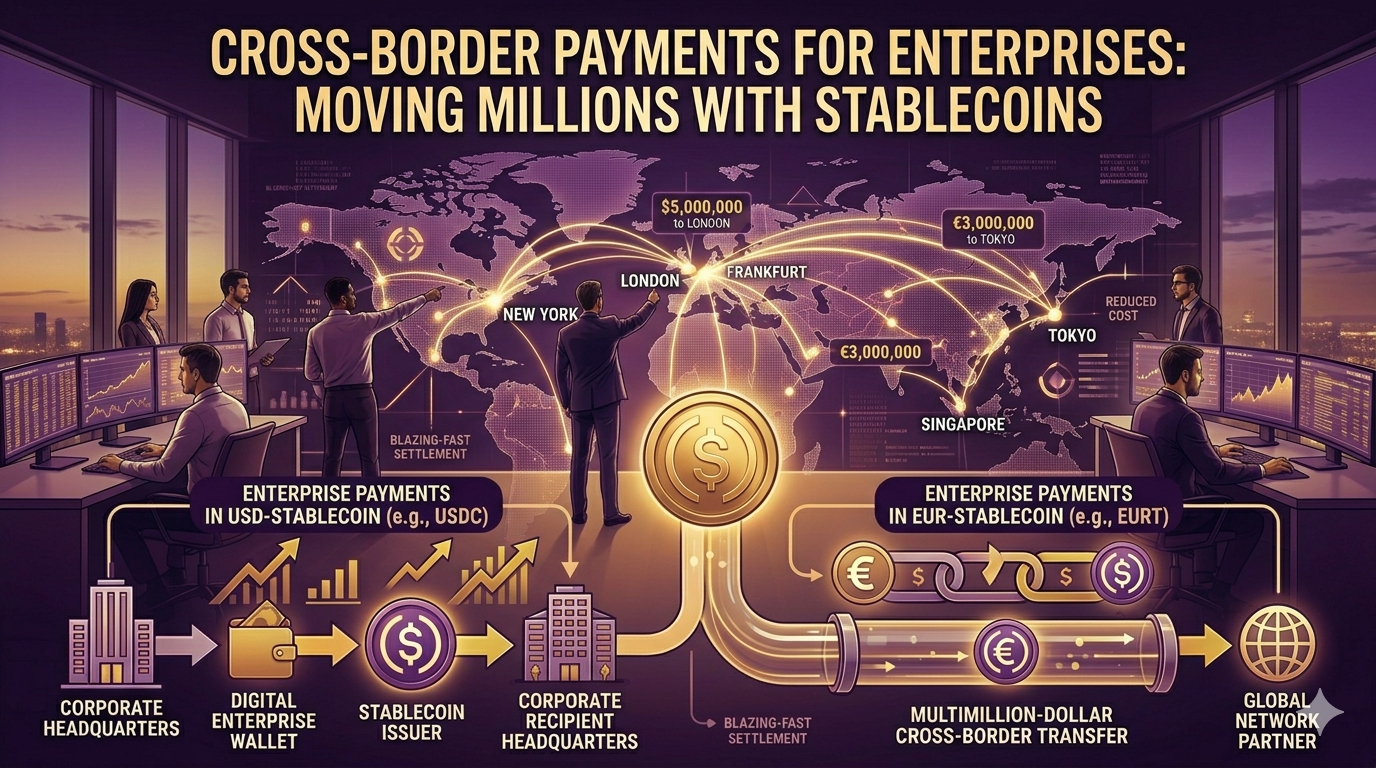
👉 Stablecoin-based cross-border payment systems
What Makes Stablecoins Relevant for Enterprises
Stablecoins are digital assets pegged to stable currencies like the US Dollar.
For enterprises, this means:
Predictable value
Reduced financial risk
Faster transactions
Key Advantages:
1. Instant Settlement
Transactions can be completed within minutes.
👉 This significantly improves operational efficiency.
2. Reduced Costs
By eliminating intermediaries, enterprises can reduce:
Transaction fees
Processing costs
3. No FX Volatility
Stablecoins remove the need for currency conversion.
👉 Payments remain consistent and predictable.
4. Full Transparency
Blockchain infrastructure provides:
Real-time tracking
Clear transaction records
Moving Millions: Why Scale Matters
For enterprises, the impact of payment efficiency increases with transaction size.
Example Scenario
An enterprise sending $2,000,000 internationally:
Traditional system:
High fees
FX losses
Delays
Modern system:
Faster settlement
Lower cost
Predictable outcomes
👉 Even a 3% cost reduction can result in significant savings.
Enterprise Use Cases
1. Global Supplier Payments
Large organizations often work with suppliers across multiple regions.
Efficient payments ensure:
Strong relationships
Reliable supply chains
2. Multi-Country Operations
Enterprises managing global teams need seamless fund transfers.
3. Large Contract Settlements
High-value contracts require:
Speed
Accuracy
Reliability
4. Cross-Border Trade
Efficient payments are essential for international trade operations.
Strategic Benefits for Enterprises
Adopting modern payment systems provides more than cost savings.
Improved Financial Control
Real-time visibility allows better decision-making.
Faster Business Cycles
Quick payments enable faster execution of operations.
Competitive Advantage
Efficiency in payments can differentiate enterprises in global markets.
Scalability
Modern systems support growth without increasing complexity.
Risk Considerations for Enterprises
Enterprises evaluating new payment systems should consider:
Compliance requirements
Security infrastructure
Operational integration
Scalability
👉 A well-designed system addresses all these factors.
The Role of Technology in Enterprise Payments
Technology is reshaping how enterprises handle payments.
Key trends include:
Automation
Real-time processing
Digital infrastructure
👉 Enterprises that adopt these trends gain long-term advantages.
The Future of Enterprise Cross-Border Payments
Global payment systems are undergoing a transformation.
Enterprises are moving toward:
Faster systems
Lower-cost infrastructure
More transparent processes
Stablecoin-based payments are becoming a key part of this shift.
Conclusion
For enterprises, cross-border payments are no longer just operational tasks — they are strategic assets.
By adopting modern payment infrastructure, organizations can:
Reduce costs
Improve efficiency
Scale globally
Final Thought
If your enterprise is moving millions across borders…
👉 The question is not whether your payment system works
👉 It’s whether it’s holding your business back
Frequently Asked Questions
Why are cross-border payments important for enterprises?
They enable global operations, supplier payments, and international trade.
How can enterprises reduce payment costs?
By using systems that eliminate intermediaries and reduce FX losses.
Are stablecoin payments suitable for enterprises?
Yes, they offer speed, efficiency, and scalability.
Can enterprises move large amounts using modern systems?
Yes, modern infrastructure supports high-value transactions efficiently.