Executive Snapshot
For businesses operating in Africa, sending and receiving international payments in USD is essential. Yet, traditional systems make USD business payments in Africa slow, expensive, and unpredictable.
This guide breaks down:
Why USD payments are critical for African businesses
Where costs and delays actually come from
How modern payment infrastructure is improving speed and efficiency
Practical ways to optimize high-value transactions ($50K–$10M)
Why USD Payments Matter in Africa
Across Africa, USD is the preferred currency for international trade and business transactions.
Businesses rely on USD for:
Import/export transactions
Supplier and vendor payments
Global service payments
Enterprise-level transfers
Why USD?
Stability compared to local currencies
Global acceptance
Easier international trade
👉 For most businesses, USD payments are not optional — they are fundamental.
The Current Problem with USD Business Payments in Africa
Despite their importance, USD payments remain inefficient.
1. Multi-Layer Banking Structure
A typical payment flow involves:
Local bank
Correspondent bank
Intermediary banks
Recipient bank
👉 Each layer adds cost and delay.
2. High Transaction Costs
Businesses often pay:
Bank fees
Processing fees
Intermediary charges
👉 Total cost: 5%–10% per transaction
3. FX Conversion Challenges
Even when sending USD:
Currency conversions may still occur
Exchange rate margins apply
👉 Hidden costs reduce final value.
4. Settlement Delays
Payments can take:
👉 2–5 business days (or more)
5. Limited Payment Visibility
Businesses often lack:
Real-time tracking
Accurate timelines
Fee transparency
The Real Cost of USD Payments (Example)
Consider a business sending $750,000 internationally:
Fees: $20,000–$40,000
FX impact: $10,000+
Delays: Operational slowdown
👉 These costs compound over time.
How Global Businesses Are Improving USD Payments
Instead of optimizing outdated systems, businesses are shifting to new payment infrastructure.
Key Shift:
From → Bank-dependent systems
To → Digital, direct payment systems
👉 This change improves speed, cost, and reliability.
A Modern Approach to USD Business Payments
Modern payment systems use digital infrastructure to simplify cross-border transactions.
What Changes?
Fewer intermediaries
Faster processing
Lower transaction costs
More transparency
Key Benefits of Modern USD Payment Systems
⚡ Faster Settlement
Payments are processed in minutes instead of days.
💸 Lower Costs
Reduced dependency on intermediaries lowers fees significantly.
💱 No Currency Uncertainty
USD-based systems ensure predictable value.
🔍 Full Transparency
Businesses can track transactions in real time.
🌍 Global Accessibility
Operate across markets without banking limitations.
Use Cases: Where USD Payments Are Critical
1. Import & Export Businesses
Fast USD payments ensure:
Smooth trade operations
Faster shipment cycles
2. Vendor & Supplier Payments
Reliable payments improve:
Supplier relationships
Negotiation power
3. Enterprise Transactions
Large organizations need:
Speed
Accuracy
Scalability
4. Digital & SaaS Businesses
Global services require:
Seamless international payments
Consistent billing
Africa-Specific Opportunities
Nigeria
High demand for USD transactions
FX restrictions create inefficiencies
Kenya
Growing digital economy
Increasing cross-border activity
South Africa
Advanced infrastructure
High enterprise adoption
👉 These markets are leading adoption of modern payment systems.
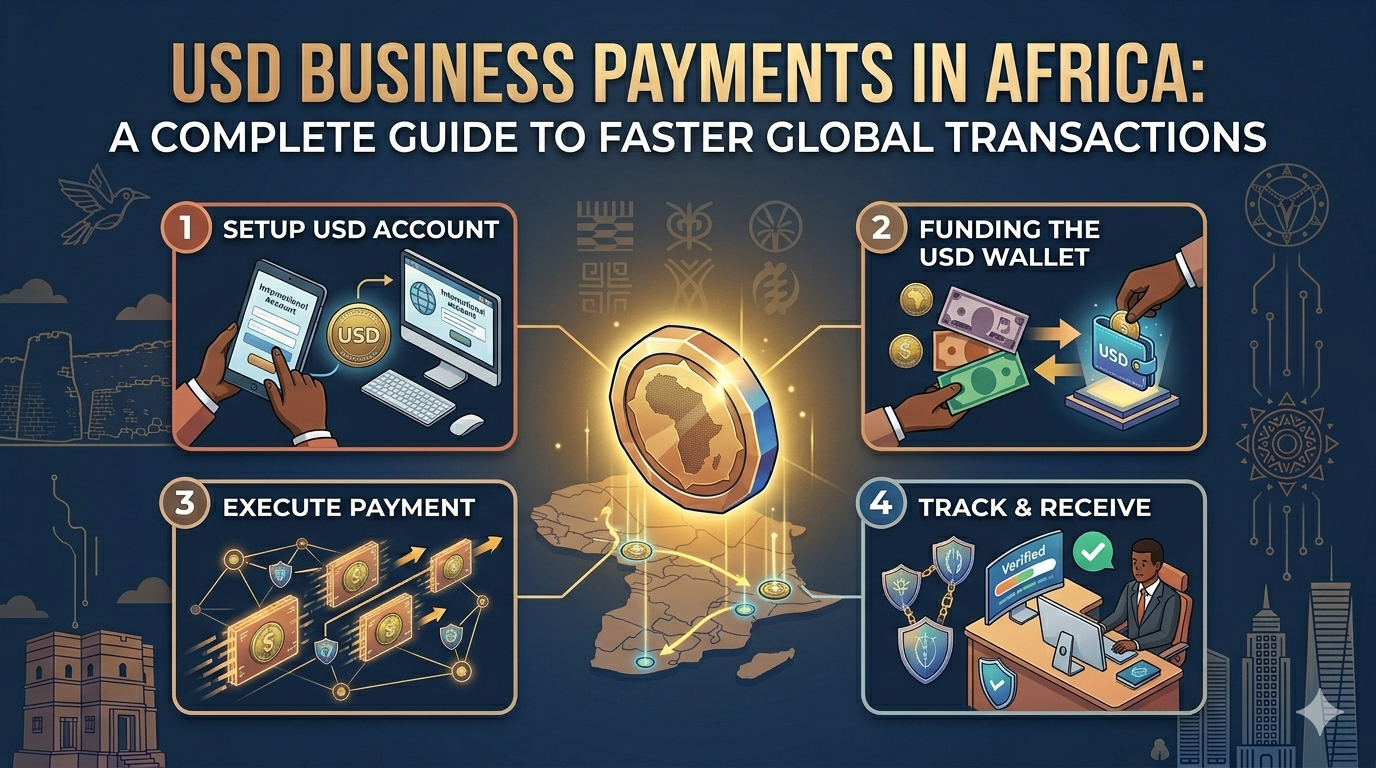
Step-by-Step: Optimizing USD Payments
Step 1: Evaluate Current Costs
Understand:
Transaction fees
FX losses
Processing time
Step 2: Identify Bottlenecks
Look for:
Delays
Intermediaries
Manual processes
Step 3: Adopt Efficient Infrastructure
Switch to systems that:
Reduce intermediaries
Improve speed
Lower costs
Step 4: Monitor Performance
Track:
Payment speed
Cost savings
Operational efficiency
Strategic Benefits for Businesses
Improved Cash Flow
Faster payments = faster operations.
Cost Reduction
Lower fees increase profitability.
Better Financial Planning
Predictable payment timelines improve forecasting.
Global Expansion
Efficient payments enable market growth.
Common Mistakes Businesses Make
Ignoring Hidden Costs
Focusing only on visible fees.
Relying Fully on Banks
Not exploring alternative solutions.
Delaying Optimization
Waiting too long to upgrade systems.
👉 These mistakes increase long-term costs.
The Future of USD Payments in Africa
The payment landscape is evolving rapidly.
Businesses are moving toward:
Faster systems
Digital infrastructure
Lower-cost models
👉 USD payments are becoming more efficient and accessible.
Conclusion
USD business payments in Africa are essential — but traditional systems are no longer sufficient.
Businesses that optimize their payment infrastructure can:
Reduce costs
Improve speed
Scale globally
Final Insight
If your business is handling high-value USD transactions…
👉 The real opportunity is not just faster payments
👉 It’s building a more efficient financial system
Frequently Asked Questions
What are USD business payments?
They are international transactions conducted in US Dollars for business purposes.
Why are USD payments important in Africa?
They enable global trade, stability, and international transactions.
How can businesses reduce USD payment costs?
By using modern payment systems that reduce intermediaries and improve efficiency.
Are USD payments slow in Africa?
Traditional systems are slow, but modern systems enable faster processing.
Can businesses send large USD payments efficiently?
Yes, with the right infrastructure, high-value payments can be processed quickly.