The Risk Has Changed — But Most Businesses Haven’t
For years, businesses trusted global banking systems without question.
That assumption is now outdated.
We are entering a new phase of financial risk — one driven by:
Artificial intelligence
Automated cyber systems
Highly interconnected banking infrastructure
This is not a future risk
This is a present, active threat environment
Understanding the New AI-Driven Cyber Threat Model
Let’s be clear about what is changing.
This is not about traditional hacking.
This is about:
AI-accelerated system exploitation
What Does That Mean?
Modern AI systems can:
Analyze financial infrastructure at scale
Identify weak points across interconnected systems
Automate attack patterns faster than human response time
In simple terms:
The speed of attack is now faster than the speed of reaction
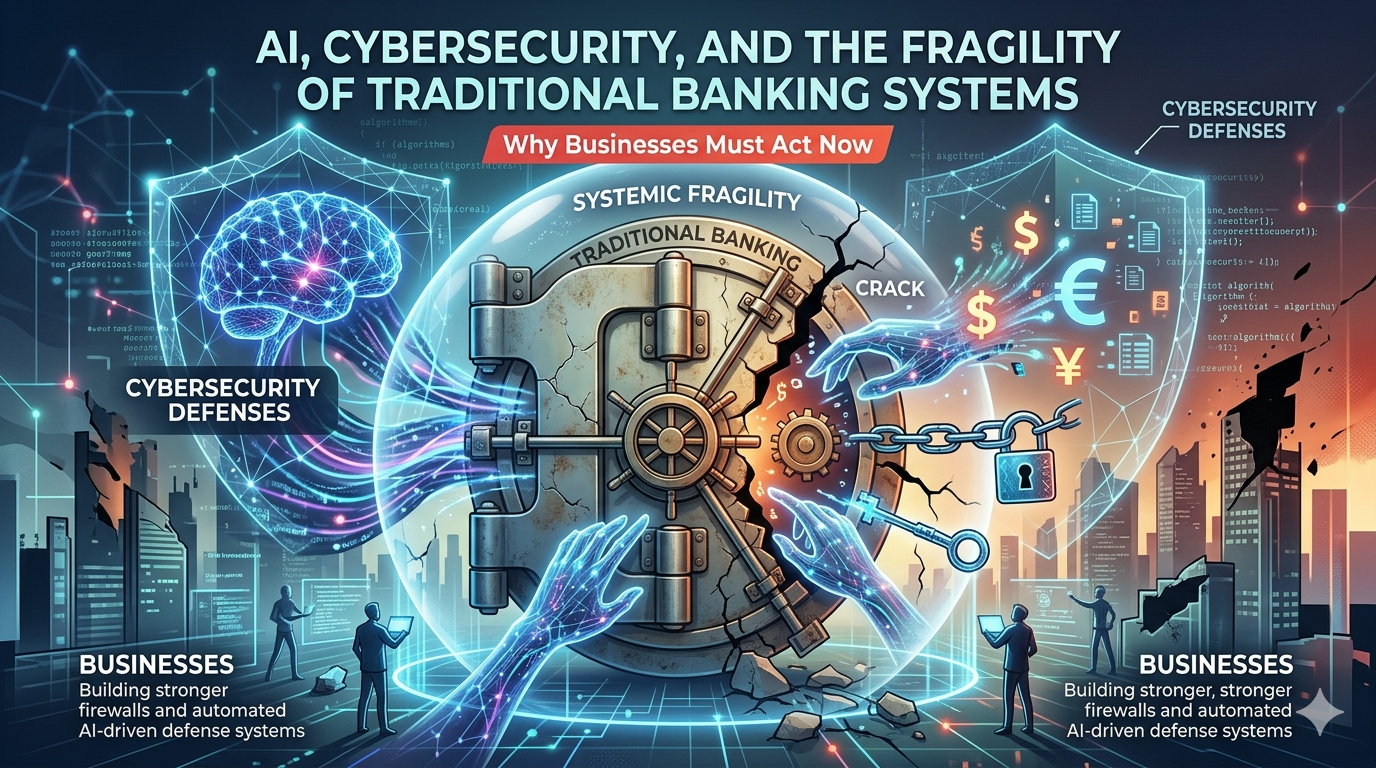
Where Traditional Banking Systems Are Vulnerable
Traditional banking relies on:
Multiple institutions
Multiple systems
Multiple validation layers
A Single Cross-Border Payment Involves:
Originating bank
Correspondent bank
Intermediaries
SWIFT messaging system
Receiving bank
Each layer is:
A dependency
A delay
A potential vulnerability
The Core Risk: Layered System Exposure
AI-driven threats exploit:
Complexity
Interconnection
Delayed response cycles
The more complex the system…
The larger the attack surface
Why This Is a Serious Business Risk
For businesses handling:
$50K–$10M+ transactions
This creates:
Payment disruption risk
Liquidity exposure
Operational instability
This is no longer just IT risk
This is financial risk
The Reality Businesses Must Accept
Traditional systems were not designed for:
Real-time AI-driven environments
Automated threat detection at scale
High-speed systemic attack vectors
There is a growing mismatch between:
Old infrastructure vs new threat capability
What a Real Solution Looks Like
Let’s be clear:
You cannot fix this problem by:
Adding more intermediaries
Increasing manual checks
Relying on slower systems
The only effective solution is:
Reducing exposure at the infrastructure level
This Is Where a New Payment Model Becomes Critical
A modern B2B digital payment ecosystem provides:
Fewer intermediaries
Controlled transaction flow
Reduced dependency on external systems
Key Advantage:
It operates outside the traditional SWIFT-based banking network
Why This Matters
This removes:
Multi-layer routing exposure
Dependency on external banking chains
System-level vulnerability points
The Role of a Proprietary Digital Payment Token
Instead of relying on:
Multiple currencies
FX conversion
Bank-controlled liquidity
The system uses a controlled digital value layer
Result:
Predictable value
Simplified transactions
Reduced systemic exposure
This Is a Risk Loss Mitigation Strategy — Not Just a Payment Tool
Let’s define this clearly:
Traditional Banking:
High dependency
High exposure
Limited control
Digital Payment Ecosystem:
Reduced dependency
Controlled flow
Lower exposure surface
This is risk mitigation at the infrastructure level
What Businesses Should Do Immediately
1. Reassess Payment Infrastructure
How many intermediaries exist?
Where are dependencies?
2. Identify Exposure Points
System reliance
External control
Delayed execution
3. Adopt Controlled Alternatives
Reduce layers
Simplify flow
Improve control
Final Thought
This is not about fear.
This is about reality.
AI has changed the speed of risk
Businesses must now change the structure of payments
Because in this environment:
The safest system is not the most established
It is the one with the least exposure