The Payment That Should Have Taken Minutes
Let’s start with something real.
A logistics company in Nairobi ships goods to a distributor in Germany.
The invoice is issued: $420,000.
Everything else in the transaction is modern:
The shipment is tracked in real-time
Contracts are signed digitally
Communication happens instantly
But when it comes to payment — the most important part — everything slows down.
The payment takes four days.
When it arrives, it’s short by $11,800.
No one can clearly explain why.
This isn’t a one-off problem.
It’s a system problem.
The System Works — But At a Cost Businesses Don’t See
Most businesses accept cross-border payments as they are.
Because:
Payments eventually arrive
Banks are trusted
The system has existed for decades
But here’s the reality:
It works — but inefficiently, expensively, and without control
The Architecture Behind the Problem
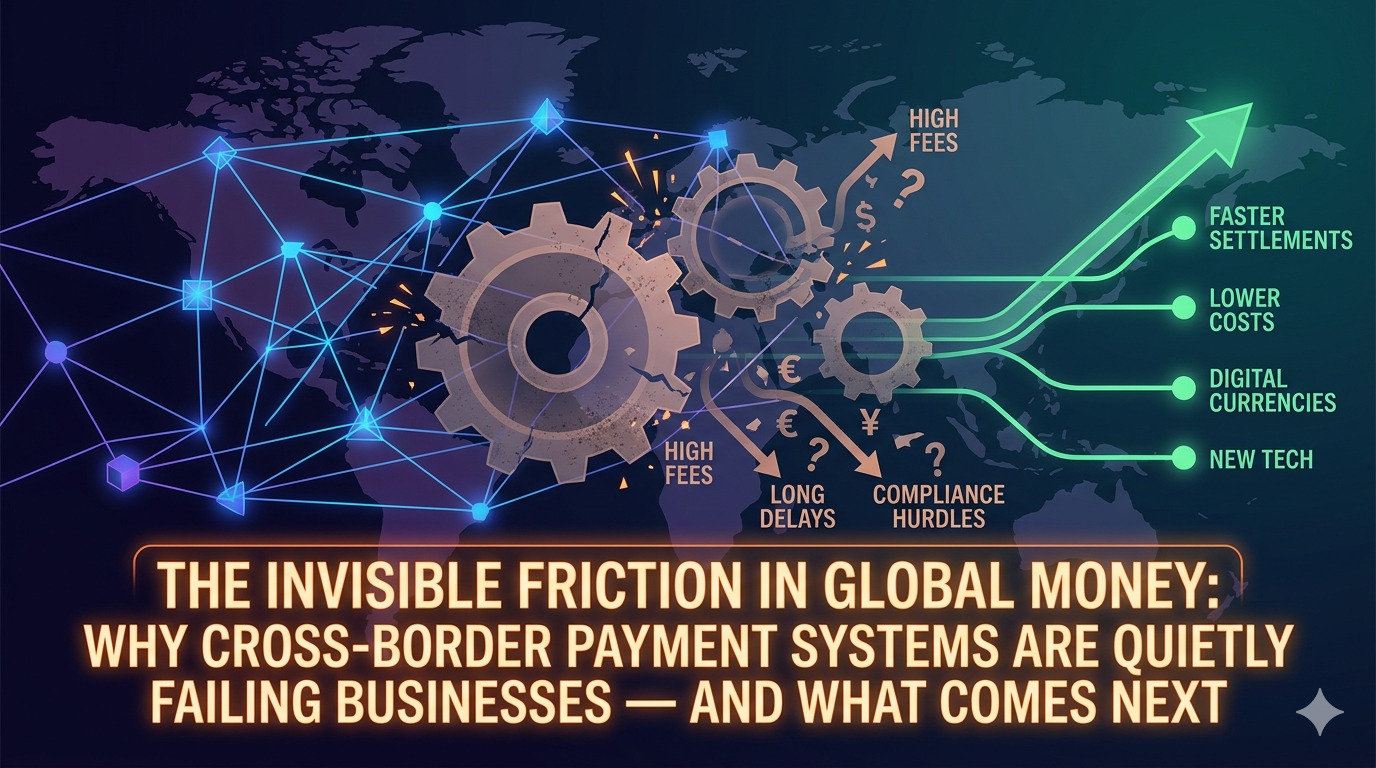
A single international payment often moves through:
Originating bank
Correspondent bank
Intermediary institutions
SWIFT network
Receiving bank
Each layer introduces:
Cost
Delay
Dependency
Risk
This is not just a payment process
It is a multi-layer dependency system
Why This Problem Is Bigger Than Fees or Speed
Most businesses think the issue is:
Fees
Delays
But those are symptoms.
The real problem is:
Lack of control over how money moves
You don’t control:
How many intermediaries are involved
What fees are deducted
When the payment settles
Where delays occur
Your money is moving through a system you don’t control
And This Is Where Risk Enters
In today’s environment, this lack of control creates more than inefficiency.
It creates:
Operational uncertainty
Financial unpredictability
Infrastructure exposure
Especially in regions like:
Africa
Latin America
Where systems are already:
Fragmented
Dependent on external banking networks
The margin for error becomes thinner
So What Does a Better System Actually Look Like?
Before jumping to solutions, we need to define what “better” means.
A modern payment system should:
Reduce dependency
Minimize intermediaries
Provide visibility
Ensure value consistency
Improve speed
But most importantly:
It should give businesses control
This Is Where a New Model Emerges
Instead of routing payments through multiple banks and systems…
A new approach is emerging:
A dedicated B2B digital payment ecosystem
Not an add-on to banking.
But an alternative infrastructure layer
How This Changes the Payment Flow
Traditional Flow
Bank → Intermediaries → SWIFT → Receiving Bank
New Model
Business → Digital Payment Ecosystem → Recipient
Fewer steps
Fewer dependencies
More control
What Makes This Ecosystem Different
This is where your client’s solution becomes critical.
1. It Operates Outside the Traditional Banking Network
The system does not rely on:
SWIFT routing
Multiple correspondent banks
This immediately removes:
Layered dependencies
External exposure points
2. It Uses a Proprietary Digital Payment Token
Instead of relying on:
Currency conversion
FX spread
Payments are executed using a controlled digital value layer
What This Achieves:
Predictable value transfer
Reduced currency friction
More efficient settlement
3. It Is Built Specifically for B2B Transactions
Unlike generic payment systems, this ecosystem is designed for:
High-value transactions ($50K–$10M)
Which means:
Scalable infrastructure
Business-focused workflows
Enterprise-grade efficiency
4. It Reduces the Exposure Surface
Remember earlier:
More layers = more risk
This system:
Reduces intermediaries
Simplifies flow
Centralizes control
Result:
Lower structural exposure
5. It Improves Visibility and Control
Businesses gain:
Clear transaction flow
Better tracking
Predictable outcomes
This is something traditional systems struggle to provide
What This Means in Real Terms
Let’s go back to the $420,000 payment.
In the Traditional System:
Delayed
Reduced in value
Unclear process
In a Controlled Digital Ecosystem:
Faster execution
Full value transfer
Clear transaction path
The difference is not just speed
It is certainty
Why This Matters Now More Than Ever
In today’s environment:
Systems are interconnected
Risks are evolving
Dependencies are increasing
Businesses can no longer afford:
Blind reliance on complex infrastructure
They need:
Controlled, resilient alternatives
This Is Not About Replacing Banks
Let’s be clear.
Traditional banking systems will continue to exist.
But forward-thinking businesses are:
Reducing dependency
Adding alternative layers
Optimizing how money moves
The Strategic Advantage
Businesses using more controlled payment systems gain:
Better Cash Flow
Faster, predictable payments.
Higher Retained Revenue
Lower hidden costs.
Operational Confidence
Fewer uncertainties.
Stronger Global Position
Ability to operate across markets efficiently.
This is not operational improvement
This is strategic positioning
The Shift Has Already Begun
This transition is not hypothetical.
It is already happening:
Quietly
Gradually
Strategically
Businesses are not waiting for systems to change
They are choosing better systems
Final Reflection
Let’s go back to that first payment.
The real issue was never just the delay.
It was this:
The business had no control over the system moving its money
Now there is an alternative.
Final Thought
In global business:
Speed matters
Cost matters
But ultimately:
Control matters most
Because the businesses that control how money moves…
Control how they grow
Frequently Asked Questions
What is wrong with traditional cross-border payments?
They rely on multiple intermediaries, leading to delays, costs, and lack of control.
What is a digital payment ecosystem?
A system designed to process payments directly with fewer dependencies.
How does this reduce risk?
By minimizing intermediaries and simplifying transaction flow.
Is this suitable for large transactions?
Yes, especially for B2B payments between $50K and $10M.
What is the biggest advantage?
Greater control, predictability, and efficiency.